


Pop-up retail now forms part of mainstream marketing. Companies can appear in city centres, retail parks, or festivals, turning vacant space into branded environments within days. Drinks brands such as Red Bull and Jubel launch short campaigns tied to product drops. They support those launches with visible pop-ups that reflect the speed of their marketing activity.
Retail activations no longer unfold over months of planning. There can be delays from marketing teams committing late. Products may also not arrive on time, while venues may only confirm at the last minute. The pressure to deliver is then on print and hardware suppliers. It becomes less about creativity and more about timing. Signage needs to keep up with campaigns that refuse to slow down.
How Quickly do Retail Activations Need to Launch?
Traditional retail fit out schedules do not usually apply to pop-up activity. Brand managers identify a location, secure permissions, then quickly get artwork approved. The installation date closes in fast. Every delay narrows the production window.
Branded assets need to be easy to travel with and assemble quickly. Those assets also need to stand tall in open environments. Lightweight structures also suit car park promotions.
Speed alone does not solve the problem. Print quality still matters. As does the tension of the fabric used and how well-built the pole is. Suppliers must understand retail pressure and respond without drama.
Can Rapid Production Meet Brand Expectations?
Marketing departments chasing promotional flags with a fast turnaround in the UK usually do so under real pressure. Late artwork often lands on a Friday with a launch looming the following weekend.
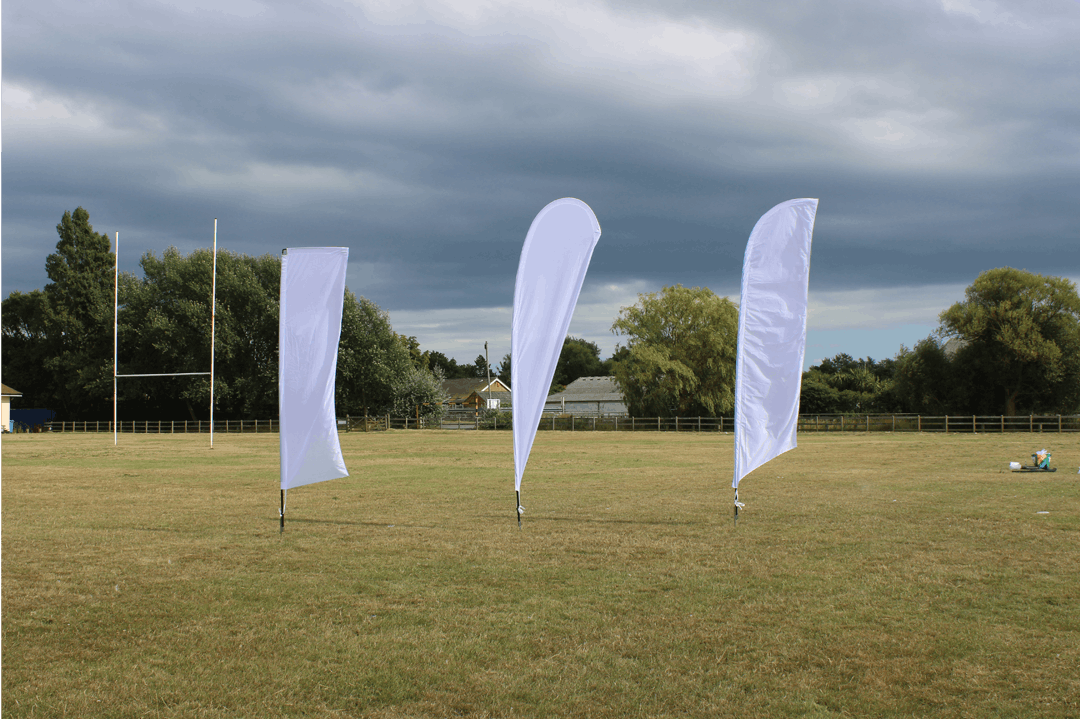
For pop-up teams, vertical feather flag formats provide presence that rises above crowd level. Their height draws attention from a distance, and their compact size means they can be transported easily.
Dye sublimation on polyester fabrics produces vivid colour saturation while allowing fabric to move naturally outdoors.
Red Bull deploys promotional banners around sampling vans, creating a branded perimeter that frames the experience. Pairing with banner walls supports clear brand storytelling and a fast installation.
Do Urban Pop-Ups Benefit From Lightweight Display Systems?
Activations in city centres should be versatile. Pavement space falls under council regulation, therefore those installing them face strict time limits, especially as public footfall patterns shift hourly.
Mixing promotional flags and banners together provides a solution that avoids heavy structural builds. A weighted cross foot or water filled base anchors the unit while allowing relocation if adjustment is needed. That mobility suits shopping centres and street events where layout changes can happen on the day.
Placed along queue lines, banners create depth with graphics stretched smoothly. Urban pop-ups also benefit from how they can be stored. Crews can dismantle them at the end of each use, before moving straight to the next location.
Campaigns consisting of last-minute retail promotion flags in the UK use a trade sign supplier that can deliver rapidly. Companies want their stock manufactured, printed and dispatched within days, not weeks. UK-based production reduces transit delays and gives buyers clearer oversight of scheduling.
How Important is Supplier Response Time For Retail Campaigns?
Time does not always allow retail teams to educate new suppliers mid-campaign. They need partners who understand the pace of retail campaigns. Artwork checks happen swiftly and the requested hardware is matched with what is in stock. Delivery tracking also remains transparent.
At temporary sites, promotional flags can often be the first layer of branding. Their placement marks territory and guides foot traffic. A supplier that stocks multiple pole heights and flag shapes can recommend suitable formats based on pavement width or forecourt size.
A trade sign supplier rapid flag delivery service rests on in-house production control. Printing and stitching carried out in the same place, by the same supplier, removes third-party bottlenecks.
Used together, these formats allow activity to be scaled without redesigning artwork. A master illustration can be adapted across feather and teardrop-shaped formats. It can then be extended onto horizontal banner panels.
Key checkpoints before approving production include:
- Confirming the fabric type aligns with the expected exposure level
- Checking pole diameters match existing fittings
- Verifying the artwork suits each format
Strong communication at this stage reduces site-level friction once installation begins.
Do Pop-Up Campaigns Still Depend on Portable Display Formats?
High-tempo campaigns are constantly moving. Visits to universities call for equipment that travels easily and a fast set up. Branded backdrops for photography and social content use promotional banners and extend campaign reach even further than the physical footprint.
How a feather flag moves can amplify that with customers spotting them from across a plaza and approaching out of curiosity.
Clear boundaries around branded spaces can also come from promotional flags and banners. Teams can control the flow of people using clear graphics to signal entry and exit points.
Jubel has used pop-up bars and outdoor sampling rigs to launch new flavours. Portable display formats allow them to test new markets before committing to permanent listings.
How Should Retail Teams Plan Graphics Under Time Pressure?
Planning artwork under pressure requires discipline. Designers must understand template constraints from the outset. Bleed allowances and safe zones must match hardware specifications. Scale ratios also need to be reviewed carefully.
Designs for promotional flags should read vertically with large typography and simplified messaging supporting legibility at distance. High-contrast imagery also helps. Detailed copy does not translate well onto moving fabric.
Horizontal banners accommodate detailed product imagery as well. QR codes, social handles, and promotions can be integrated more comfortably. A balanced rollout may involve three flag positions at the edges of a site, with banner graphics behind product stations.
Those searching for last minute retail promotion flags in the UK options must work out installation windows against courier cut off times. Defined artwork approval checkpoints reduce late revisions that jeopardise dispatch schedules.
Close collaboration between marketing and production teams keeps tight timelines manageable. Open dialogue about print methods and fabric availability gives everyone visibility on progress.
Are Faster Turnarounds Now Normal?
Brand culture has shifted. Limited edition releases and event-driven marketing push timelines forward. Experiential retail adds further pressure.
Together, promotional flags and banners give retail teams a toolkit that adapts to each location. Rapid production within the UK keeps transport distances manageable and response times aligned.
Are you preparing a pop-up that demands speed and precision? Contact us to discuss production timelines and artwork preparation for your next campaign.


