


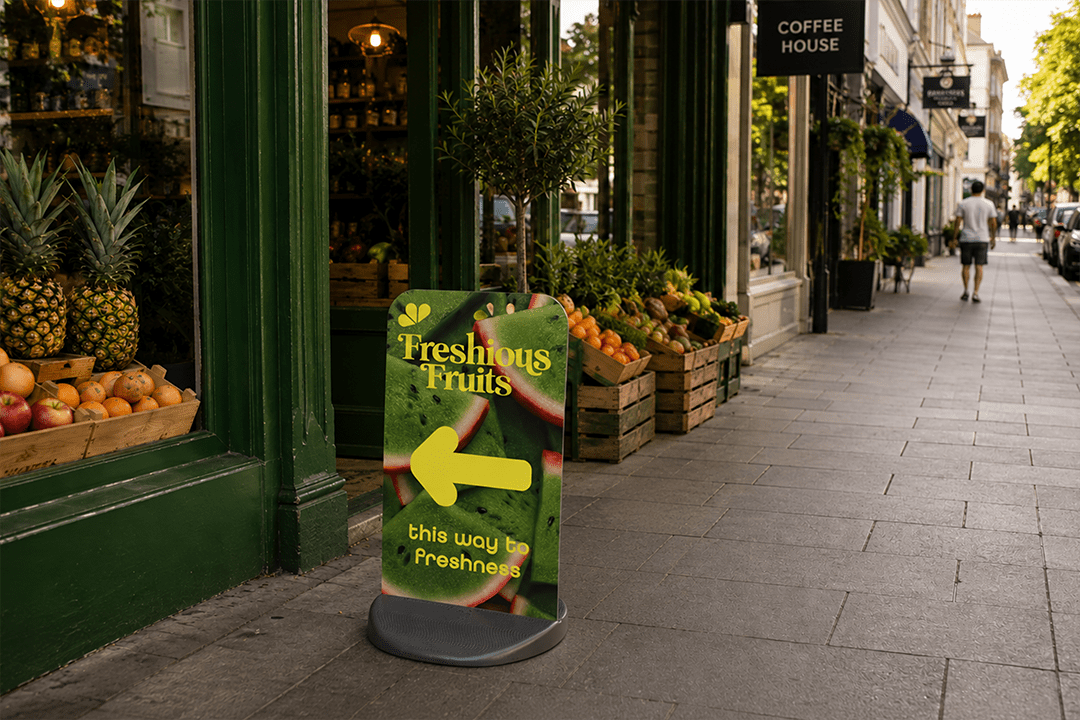
The ‘Eco’ in ‘Ecoflex’ reflects not just the low price point (‘economical’) of the UK’s best-selling pavement sign but also the design strategy applied to the product’s development and manufacture.
Eco-design principles are methods used to minimise a product's environmental impact across its full life-cycle, from raw material selection and manufacture, to distribution, function/use and disposal - without compromising product performance.
The core principles of eco-design focus-in on reducing waste, conserving resources, and promoting a circular economy.
A stand-out feature of Ecoflex is the use of just 3 quick to assemble, and quick to disassemble, components.
Sometimes referred to as dematerialisation or part consolidation within the design process, minimal parts in a product directly advances the core objectives of eco-design. A reduction in the number of components in a product minimises resource consumption, optimises the product’s life cycle and lowers the product’s embedded carbon footprint. Fewer parts can mean fewer fixings and so a faster, more cost-effective disassembly process.
Whilst not one of the listed eco-design principles per se, ‘the efficient use of materials’ is commonly recognised within product design as the most effective tactic to address multiple eco-design principles simultaneously.
OK, so what are the recognised eco-design principles, and where do they come into play in the Ecoflex pavement sign?
Use of Sustainable Materials
• The Ecoflex panel is powder coated aluminium. Aluminium is infinitely recyclable without loss of quality or performance and the powder coated finish does not hinder the recycling process. According to the International Aluminium Institute, the global trade association representing the primary aluminium industry, 75% of all aluminium ever produced is still in active circulation.
• The Ecoflex base is made from 100% industrial-reclaim polymer, essentially recycled waste cable insulation and kitchen flooring. It can be recycled multiple times without loss of performance.
• The Ecoflex ‘wedge’ is manufactured in high performance polycarbonate. Virtually unbreakable, replacement becomes unnecessary.
• The Ecoflex packaging is produced from a minimum 80% recycled material.
Design for Longevity and Repair
Creating high-quality, durable goods that last is fundamental to eco-design principles, as is a product designed with modular parts so they can be easily repaired or replaced rather than being thrown away when a single component fails. Ecoflex ticks all the boxes in this respect:
• The special ‘aircraft grade’ aluminium panel is designed and tested to flex, without permanent bending, in winds up to 60mph! It makes the Ecoflex the most stable wind resistant sign of its type on the market.
• The base and ‘wedge’ fixing are virtually indestructible and will last for years if not decades, and well beyond the working life of even the longest outdoor promotion.
• No tools are required to dismantle and isolate a component, which can be undertaken in a matter of seconds.
• All components are held in stock for a fast repair, replacement or promotional message update.
Plan for End-of-Life and Recycling:
Design for Disassembly (DfD) is a primary rule of the circular economy. A product must be easy to dismantle at its end-of-life so materials can be separated and recycled. No other sign product of its type facilitates this as easily as Ecoflex:
• Only 3 component parts – all recyclable.
• Component parts can be separated in seconds.
• No tools required.
Optimise Production and Logistics:
This is mainly about reduction in carbon emissions. From a production perspective the small number of components in an Ecoflex means:
• Fewer Embedded Emissions: Relying on fewer components directly reduces the total raw material volume required, preserving natural ecosystems.
• Leaner Supply Chains: Manufacturing fewer unique parts requires fewer production moulds, less tooling machinery, and reduced factory energy consumption.
From a transport and logistics perspective Ecoflex’s compact flat-pack design means:
• Freight Efficiency: more units to a pallet or shipping container.
• Lower Emissions: Maximising shipping volume reduces transport-related fuel consumption and greenhouse gas emissions.
Information Transparency:
One of the key tenets of Eco-design is to share information in a transparent ‘pay-it-forward’ kind of way, providing clear, accessible information regarding a product's sustainability and disposal. So, with that in mind, and to round off this article here’s some links to further reading material for the curious:
Ecoflex;
https://www.youtube.com/watch?v=ylRfsMZ4XfM
Canadian Wind Tunnel test - Ecoflex


