


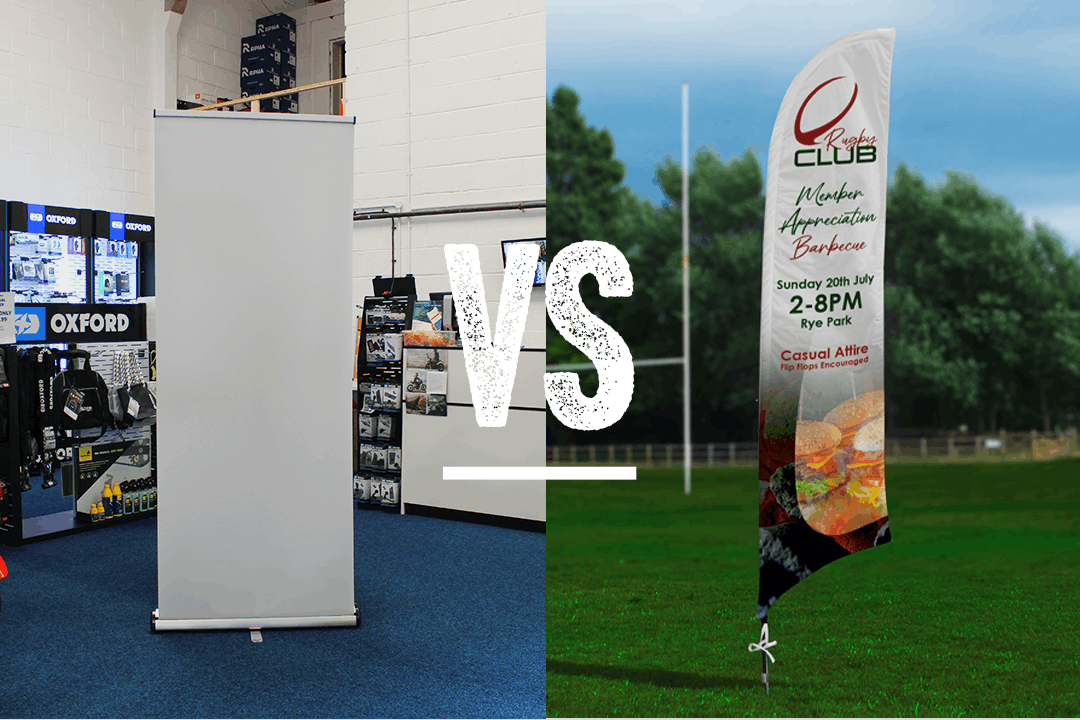
High streets, trade shows and forecourts all have to win attention in seconds. Brands want displays that travel easily and can be set up fast. It also needs to stay looking smart after lots of full days of passing traffic. Roller units and feather flags both promise height and colour in a compact footprint, yet they behave very differently once they are in place.
Choosing between them starts with the way people move past each site. Indoor aisles and exhibition walkways feel very different to open car parks or roadside verges. Think about how far away the viewer stands and how quickly they pass. Also factor in what already competes for attention nearby. From there, it becomes easier to pick the format that gives the message the best chance to land.
How do Banner Units Compare With Flags?
Both banner units and feather flags use height to bring messages into a busy field of view. They take up less floor space than many other fixture types and present a flat panel that reads like a page, while feather flags have a curved profile that sways in the breeze.
Set-up also differs. A banner unit pulls up from a weighted base and attaches to a support pole, so most of the print stays taut. Feather flags thread onto a vertical mast and either fix via a ground stake or alternative mounting solution, depending on the location. That movement helps catch the eye outside, yet it can be distracting indoors.
Where Should Banner Stands Work Indoors?
Indoor venues share some patterns. Traffic usually flows along predictable routes, past entrances and through key decision points such as checkouts or service counters. Banner units can sit just off those paths, so they guide people without getting in the way.
Typical placements for roller banners indoors include:
- Near store or venue entrances where people slow briefly as they cross the threshold
- Along the edge of main aisles so messages stay in the line of sight without blocking shelves
- Beside reception desks or service counters where visitors wait for attention
Because bases stay close to the floor and the print rises vertically, these units can share space without crowding people. Staff still have room to move stock and trolleys around.
Where to Position Feather Flags Outdoors
Open air sites often favour motion. On forecourts, pavements near car parks and approaches to leisure venues, a fixed board can disappear into background signage.
Many brands use flags to mark entrances on wider sites such as retail parks or drive-through lanes, pairing them with roller banners for detailed messages. A line of masts creates an avenue that leads drivers toward an access road. Seen from a distance, the repeated shapes build recognition for a location before detailed messages come into view.
Used well alongside static boards and fascia signage, feather flags give a helpful cue that something is happening. In these layouts, roller banners stay close to the point of entry while flags carry the same colours further out along approach roads.
How Should You Plan Roller Banner Artwork?
Narrow banners behave more like tall posters than street furniture. The copy sits in a single column, so hierarchy matters. A headline needs to sit in the top third, where it can be read across a room. Sub-headings, concise bullet points and a clear call-to-action can then follow in stages down the panel.
Designers working on roller banners often divide the print into zones. The top carries the main message and brand identity. The mid-section holds a product shot or supporting statement, while the lower area has contact details or a web address. That structure helps people who only catch a glance to still take away something useful.
It also helps to think about how stands will line up. A set of three or four banners can act like a mini backdrop behind a reception desk or tasting table. Repeating the same headline across each unit, then varying imagery, gives a joined-up feel without demanding complex artwork.
What Artwork Works For Feather Flags?
Flag layouts often need a different approach to banner artwork. Campaigns that already use roller banners indoors can often share the same themes, with flag artwork rewritten in a shorter format. The canvas narrows toward the bottom and curves at the top, so messages that work on straight rectangles are unlikely to behave the same way.
Useful guidelines when planning artwork for feather units include:
- Keep main words in the upper half where they stay in view for longer
- Keep phrases brief so lines do not disappear
- Place logos high and tight so they read cleanly even when the flag moves
- Use high contrast between the background and typeface so messages stand out on bright days
It also helps to check how the reverse looks on site. Some feather flags have double sided print options which may be a consideration in locations where they are approached from either direction.
What Factors Affect Storage and Transport?
Roller units and flag kits pack down in different ways. A banner stand usually travels in rigid housing. A soft carry case keeps the parts together in transit. Masts break down into shorter lengths that strap with the folded fabric.
Teams buying roller banners for multi-site campaigns often value how fast they stack into vans or onto pallets. The rigid housings make them easier to count and scan. Flag hardware fits into slimmer bags and can be carried further by hand across fields or event sites.
Water-filled bases and ground pegs suit outdoor jobs, yet they must be matched carefully to the surface and wind exposure at each site. Heavier banner units sit happily on hard floors indoors, with adjusters to help keep it upright on slightly uneven surfaces.
Which Campaigns Suit Each Format?
Different campaigns lean toward different hardware. Static panels give time for longer messages, while moving graphics tend to work better for quick prompts near faster traffic.
Examples that often suit roller banners include:
- Store guides that help visitors understand where departments and services are located
- Brand introductions that set out who you are at exhibitions, open days or roadshows
- Event schedules near registration desks or seminar rooms
Feather flags frequently support:
- Brief bursts of activity during launches or open days, including match promotions in sports club grounds
- Site entrances
- Footpath approaches
Framing campaigns like this makes mixed kits easier to brief. Roller units handle the detailed reading near the point of decision, while flags help catch the first glance at distance.
How Can You Test on Site?
Trials help teams pick the right mix for each location. A simple way to begin is to select two or three priority sites and plan a brief rotation. One month might focus on roller banners placed near the door, the next might swap those for flags at the same positions.
During each phase, teams can note how many enquiries or sales link back to the promoted message. Asking customers where they first saw an offer, even in a quick informal way, can reveal how far each format has worked.
Where budgets allow, some brands run both formats at once in small clusters, using roller banners for fuller messages and flags for quick prompts. A banner stand near the entrance carries the full details and call to action. A flag at the edge of a site picks up the headline only. Together, they form a path from first sighting through to the point where someone steps inside to act.
Get Support for Your Next Banner Project
We design and make signage hardware for trade buyers across the UK. If you are planning new activity built around roller banners and feather flags, contact us.


